

Knowledge Base
Knowledge Base
Knowledge Base
Knowledge Base


Knowledge Base

Standard Containers (Dryvan) Standard containers are containers used for general purposes. Transportation of all kinds of dry cargo is provided with these containers. Although their dimensions are generally 20′ and 40′, 45′ and recently 54′ long containers have also started to be used.
High Cube Containers Although this type of container is structurally similar to standard containers, with a height of 2896mm compared to box containers with a height of 2591mm, it is a container type that allows for more internal volume loading. They are generally produced as 40′. Their usage areas are in the transportation of all kinds of dry cargo, light and bulky cargo, and out-of-gauge cargo up to 2.7m in height.
Standard Containers (Dryvan) Standard containers are general-purpose containers used for transporting all types of dry cargo. While their dimensions are usually 20′ and 40′, 45′ and recently 54′ long containers have also started to be used.
High Cube Containers While these types of containers are structurally similar to standard containers, with a height of 2896mm compared to the 2591mm height of box containers, they are a type of container that offers a larger internal volume for loading. They are generally manufactured as 40′. Their areas of use include the transport of all kinds of dry cargo, light and voluminous cargo, and out-of-gauge cargo up to 2.7m in height.

Flatrack Containers Flatrack containers are transport units consisting of a base platform and two end walls. When necessary, the end walls can be fixed upright or folded down flat against the base to transform it into a transport platform. They are generally manufactured in 20′ and 40′ dimensions. Their areas of use are heavy-tonnage cargoes and wide or high out-of-gauge cargoes. They are also used for transporting and securing high-volume break-bulk cargoes by creating a platform from two or more flatrack containers.
Platforms (plats) Platforms structurally consist only of a base platform. They do not have end or side walls. They are suitable for transporting heavy-tonnage cargoes in a small area. Their dimensions are generally manufactured as 20′ and 40′. Their areas of use are out-of-gauge cargoes and heavy-tonnage cargoes.
Flatrack Containers Flatrack containers are transport vehicles consisting of a base platform and two end walls. When necessary, the end walls can be fixed upright or collapsed down onto the base to transform it into a transport platform. They are generally manufactured in 20′ and 40′ dimensions. Their areas of use include heavy-tonnage loads, and wide or high out-of-gauge loads. They are also used for transporting and securing high-volume break bulk cargo by creating a platform from two or more flatrack containers.
Platforms (plats) Platforms structurally consist only of a base platform. They have no end or side walls. They are suitable for transporting heavy-tonnage loads in small spaces. Their dimensions are generally manufactured as 20′ and 40′. Their areas of use include out-of-gauge loads and heavy-tonnage cargo.
All container dimensions in the table above are outlined. Shippers must take tolerance margins into consideration.
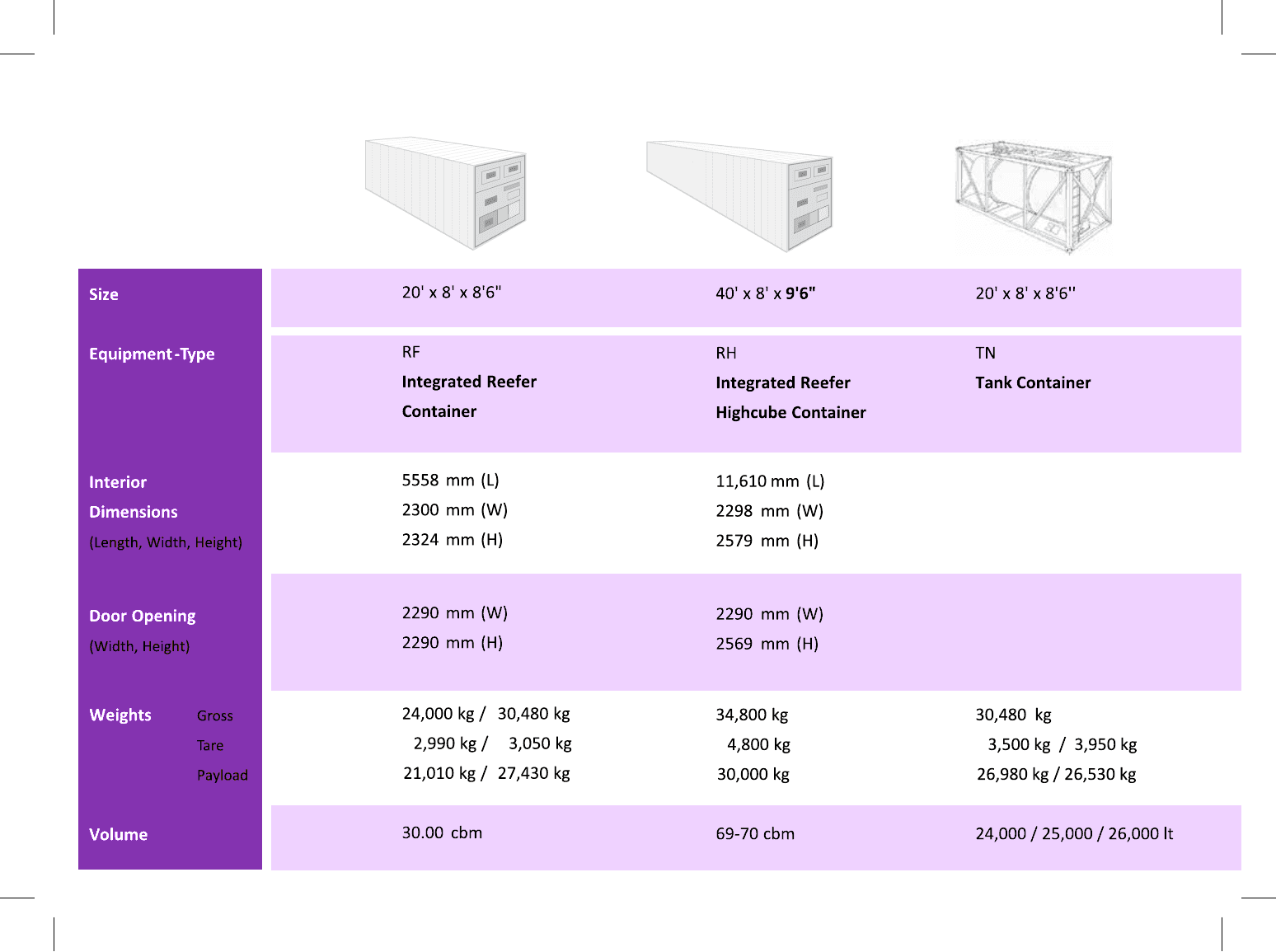
Refrigerated (Reefer) Containers Refrigerated (Reefer) containers are specially insulated containers with an internal cooling unit. They are generally produced in 20' and 40' sizes. High cube containers are used for transporting light and bulky cargoes (flowers, fruit, etc.). Their natural use is for food products transported at a constant temperature below or above 0 ºC.
Tank containers Tank containers are used for the transport of liquid or gaseous cargoes. A cylindrical tank is placed inside a steel rectangular construction frame.
Refrigerated (Reefer) Containers Refrigerated (reefer) containers are specially insulated containers with an integrated cooling unit. They are generally produced in 20′ and 40′ sizes. High cube containers are used for transporting light and bulky cargoes (flowers, fruit, etc.). Their natural use is for food products transported at a constant temperature below or above 0 ºC.
Tank containers Tank containers are used for transporting liquid or gaseous cargoes. A cylindrical tank is placed inside a steel rectangular frame structure.
Refrigerated (Reefer) Containers Refrigerated (Reefer) containers are specially insulated containers with a cooling unit inside. They are generally produced in 20′ and 40′ sizes. High cube containers are used for transporting light and bulky cargoes (flowers, fruits, etc.). Their natural use is for food products transported at a constant temperature below or above 0 ºC.
Tank containers Tank containers are used for transporting liquid or gaseous cargoes. A cylindrical tank is placed inside a steel rectangular construction structure.

Open Top Containers The difference between open top containers and standard containers is that their roof is completely open. After loading, they are covered with a tarpaulin. Generally, their sizes are 20′ and 40′ in length. Since they allow the cargo to be loaded from the top, their natural areas of use are out-of-gauge cargoes that do not fit through the container door, and cargoes that need to be handled with equipment such as cranes.
Open Top Containers The difference between open top containers and standard containers is that the roof part is completely open. After the internal loading is completed, it is covered with a tarpaulin. Generally, their dimensions are 20′ and 40′ in length. Since they allow the cargo to be loaded from the top, their natural areas of use are out-of-gauge cargoes that do not fit through the container door and cargoes that need to be handled with crane-like equipment.
Logistics Glossary
A
A.T.A Carnet: It is a customs document that allows the temporary import and export of cargo between countries party to trade, pursuant to the Temporary Importation Convention, i.e. the Istanbul Convention and its annexes, without requesting any additional documents. Thanks to this document, transition through customs is shortened. The validity period of the document is 1 year.
Agent: Organisations or individuals working on behalf of and serving logistics companies in different regions outside the head office are called agents.
ADR: These are the standards that determine the rules required during the transport of explosive, flammable or ignitable substances falling into the class of dangerous goods by road, and the documents that vehicles carrying such dangerous goods and the drivers of those vehicles must have.
Transshipment: The process of loading cargo on any logistics vehicle onto another vehicle to ensure its shipment, without being subjected to any physical processing.
Consignee: The party receiving the cargo under the logistics service.
Warehouse: These are closed or open areas created to keep transported cargo or goods for a certain period of time if needed.
Bonded Warehouse: These are closed or open warehouse areas prepared for keeping cargo or goods within the scope of customs legislation during the completion process of customs procedures.
Demurrage / Storage: Storage is the service fee received in exchange for storing goods in the customs area, port or warehouses for a certain period of time. Prolongation of customs procedures, lack of documentation or unexpected inspections can increase storage costs. Therefore, time management is of great importance in import and export processes.
B
Waiting Time: In logistics service, it is the period during which the cargo or goods do not physically move.
Declared Value: In logistics service, it is the value of the cargo / product declared by the sender party.
Unit Train: When cargo that can fill an entire railway train is generated, it is called dedicating the entire train to that cargo. However, there is a requirement that the cargo or goods in question belong to a single company.
BAF (Bunker Adjustment Factor): BAF is a cost element added to the freight rate in maritime transport to balance fluctuations in fuel prices used by ships. It is applied by carriers if fuel prices increase and is shown as a separate item on the freight invoice. BAF plays an important role in cost calculations, especially in long-distance and container-based maritime transport.
C – Ç
CAF (Currency Adjustment Factor): Reflection of fluctuations in the dollar exchange rate on the freight fee.
CMR Convention: Road transport document used by countries that have signed the CMR Convention in international road logistics.
CMR International Consignment Note: A legal document issued by the logistics service provider on behalf of the consignee in international road logistics, reflecting that the goods or cargo have been received in good condition, will be delivered under the specified conditions, and that the contract of carriage has been drawn up.
CPT (Carriage Paid To): A logistics service process in which the seller of a good or cargo, after paying the value of the goods and all freight costs, delivers it to a logistics company determined by themselves and undertakes all transport costs until it is delivered to the person and place determined by themselves.
CIP (Carriage and Insurance Paid To): CIP is a delivery term according to Incoterms rules in which the seller undertakes the transport and insurance costs of the goods up to the agreed destination. When the seller delivers the goods to the carrier, the risk passes to the buyer. However, insurance during the transport is arranged by the seller. CIP is a delivery term suitable for multi-modal transport and is generally preferred in air and road transport.
Cross Docking: Sending products received from the supplier to the destination point by sorting them according to the customer's needs without passing to the storage stage and without changing the transport container.
Packing List: It is the packaging / parcel list showing the weight, size, quantity, pieces and numbers of the cargo inside, as well as the address and other contact information of the consignee.
D
Distributed Stock: The state of keeping the stock of the same material at different points.
Distribution: The entire set of operations that must be carried out to send a good or cargo in the predetermined quantity and at the agreed time to the agreed delivery point.
Distribution Network: It is the name given to the system in which all elements such as warehouses, routes, and sales points where a product or cargo will be located from the dispatch point to the delivery point during its logistics service are defined.
Distribution Channel: It is the name given to the entirety of the connection points in the flow of products manufactured or services provided by businesses from the production point until they reach the end user.
Distribution Centre: It is the name given to logistics facilities where products coming from a single supplier or different suppliers are stored, subjected to value-added processes, handled, packaged and shipped before moving to the distribution stage.
Warehouse: These are strategically important intermediate points where products are located in the process from the raw material stage to the production stage or from the production stage to the distribution stage.
Volumetric Weight (Desi): A word meaning volumetric weight in logistics operations. It is the value obtained by multiplying the width, length and height of the three-dimensional packaging such as case, parcel, box, package in which the product is transported in centimetres, and then dividing it by 3,000 when calculating the cargo transport fee.
Document: General name of forms such as invoice, waybill, control certificate, purchase order, certificate, document used during logistics service.
Dozvola: It is the transit pass permit that allows HGVs to transit between countries in international road logistics.
E
Electronic Product Code: It is the name given to the code created for immediate and automatic identification and tracking of a product in the supply chain on a global platform during logistics operations. The electronic product code contains information such as manufacturer info, product type and serial number of the product.
Handling: It is a term used for all operations such as changing the location of products in logistics facilities like open and closed warehouses, cold storages, licensed warehouses, bonded warehouses, etc., reorganising them by breaking their packaging, changing transport container sizes, checking, labelling, and stretch wrapping the products.
Commodity: Commodity is the general name given to a basic good / product or material such as gold, silver, oil, natural gas, copper, cotton, sugar, etc., which is subject to trade, can be obtained from different producers, and is generally of a single type of quality.
Inventory: A detailed list of all movable and immovable goods, fixtures and stocks belonging to a business.
ETA: Estimated date of arrival of a cargo at the delivery point.
Ex Declaration: Export declaration.
Euro Pallet (EUR – Pallet): Euro pallet is a type of pallet whose standards are determined by the European Pallet Association and is widely used in international transport. Its standard dimension is usually 80×120 cm. Euro pallets are subject to an exchange system and provide cost advantages, especially in European logistics operations.
F
FCA (Free Carrier): It is a type of transport in which the seller, who is the exporter, completes all customs procedures of the goods / cargo to be subject to logistics and delivers them to the first carrier on the predetermined date and place, with all kinds of domestic transport costs paid. It is used in all transport types. Upon delivery of the cargo to the carrier, all responsibility and risk of the goods pass from the seller to the other party.
FIFO: This definition, consisting of the initials of the words First in First Out in English, is used in stock management to explain that the product that enters the warehouse first will leave first.
Fleet Management: Managing all equipment that runs logistics processes, such as vehicles, equipment, garages, infrastructure services belonging to logistics companies, i.e. their own assets, in a proper and seamless manner is called fleet management.
Forklift: It is the name given to the fork lifter used in all handling operations such as loading, unloading, transporting, placing, stacking of goods / cargo in logistics facilities like open and closed warehouses, cold storages, bonded warehouses, etc.
Reefer Transport: It is the transport of fresh and/or frozen foods prone to spoilage with special refrigerated vehicles down to -26 degrees Celsius.
Fulfillment: Fulfillment covers the entire operational process from receiving the order to packaging, shipping and delivering the product to the customer. Especially in the e-commerce sector, it is one of the most important stages determining customer satisfaction. Fast and error-free fulfillment processes reduce return rates and increase brand loyalty.
G
Loading Gauge (Gabari): These are the dimensions that determine the length, width and height of vehicles traveling on the road, loaded and/or unloaded, in order for them to travel safely.
Concealed Damage: The situation where products inside a transport container, which initially seem undamaged, are later understood to be damaged.
Shipper / Consignor: Person or company requesting the transport of a good or product.
GPRS: It is the technology that enables the transfer of cargo data to users over the GSM network during the logistics process.
Groupage: The situation where the transport vehicle used in the logistics service is used by more than one customer.
Customs Clearance: In international trade, it is the legal document showing that all legal permits have been obtained and the vehicle can leave freely.
Customs Declaration (Bill of Entry): Customs declaration is the basic document in which the goods subject to import or export are officially declared to the customs administration. The type, value, origin and tax calculations of the goods are made through this document. All customs procedures are carried out in line with the information contained in the declaration.
Safe Area: The area reserved for the storage of products or materials specially defined for a specific reason.
Route: It is the name given to the path that a person, vehicle, good or service will follow between the predetermined start and end points.
H
Raw Material: It is the name given to the basic material processed to a large extent during the production process in order to obtain the final product.
Waybill: It is the document in the nature of a receipt, used in railway logistics and not having the characteristic of a valuable paper.
Damage: It is the loss that causes depreciation in the product, such as breakage, tearing, cracking, bending, spoilage occurring in the product during logistics processes like transport, storage, handling.
Air Waybill: It is the non-negotiable transport document prepared between the shipper person or company and the company undertaking the air logistics service.
I – İ
IATA: It is an international organisation that regulates the tariffs and customisations of passenger and cargo transport in international air logistics.
IMCO Charge: It is the additional fee requested by the shipping line in dangerous goods transport.
IMO Certificate: It is the document used in the transport of flammable, explosive and chemical cargo.
Intermodal Transport: Delivering the goods to be transported to the final destination point without any physical processing on them and without opening the container / trailer they are in, using more than one transport model (Ro-Ro, road, sea, rail).
Incoterms (International Commercial Terms): Incoterms are a set of delivery terms published by the International Chamber of Commerce (ICC) that standardise the responsibilities of the buyer and seller in international trade. It clearly defines who is responsible for transport, insurance, transfer of risk and costs at which stage. Incoterms rules prevent misunderstandings in contracts and provide legal clarity between parties.
Export: Commercial activity created by sending goods from the country they are in to another country.
Replenishment: It is the transfer process carried out within the warehouse to ensure the availability of a product in different warehouse locations or different packaging types during the storage process.
Waybill / Delivery Note: It is the official and finance-approved goods delivery document that must accompany a good when it is shipped from one place to another after its sale is made.
Stacking: The situation where materials are piled on top of each other using volume in the vertical direction in order to use limited areas efficiently.
Import: Commercial activity created by bringing goods from any country into the country of residence.
J
Jettison: In maritime logistics, if the ship carrying the cargo is in danger, it is the process of throwing the material on the ship overboard if necessary.
K
K1: It is the authorization certificate that real or legal persons who will carry out intercity goods transport by road with one or more owned vehicles must obtain from the Ministry of Transport, Maritime Affairs and Communications.
Cabotage: In maritime trade, it is a country's granting the authority to transport within its own country only to carriers carrying its own flag. In addition, in road logistics, it can also be used as commercial vehicle drivers having the right to work in other countries.
Quality Control: It is checking by grading whether a product or service meets the specified quality conditions.
Capacity: It is the highest production quantity that can be obtained according to time or different criteria under certain conditions.
Road Transport: The situation where only the road route is used from the point of origin to the point of destination in the logistics process of a good or cargo.
Multimodal Transport: The situation where at least two different transport systems are used together within the same logistics shipment.
Value Added Services (VAS): It is the entirety of labour-intensive operations applied to products waiting in the warehouse in line with customer demand, such as labelling, packaging, folding, temperature measurement, transfer, mixing, combining, separating, palletising, light assembly, return, destruction, adding user manuals, barcode processes, maintenance-repair operations, etc.
Kingpin: It is the name given to the large pin that provides the connection between the tractor unit and the semi-trailer.
Knocked Down: For a more economical loading, loading the cargo in question in disassembled form to be reassembled, rather than as a whole.
Combined Transport: It is the transport system in which the road is used in the beginning and ending stages throughout the logistics process of a cargo, and services such as maritime, railway, canal-river routes are used in the long-distance routes in between.
Full Load Transport (FTL): The situation where a transport vehicle or container is allocated to only one shipper in logistics service.
Consignment Stock: It is the name given to products for which payment is made when they are started to be used, not when they are received.
Consolidation: In transport, it is the process of combining small volume cargo into large volume cargo batches to achieve savings.
Bill of Lading: It is the loading instruction on which all information belonging to the shipper and consignee is located, and also details such as loading place and date, the point where the cargo will be delivered, type, quantity, weight, and delivery term of the cargo are specified in detail.
Container: These are metal transport boxes, which are one of the main equipments of the logistics sector, resistant to all weather conditions, especially preferred in combined transport connected to maritime transport, easily handled, allowing efficient use of space with the advantage of being stacked on top of each other, and preventing damage to the cargo / goods.
Conveyor (Conveyor Belt): A conveyor is a mechanical belt system that enables products to be automatically transported from one point to another. It is widely used in production facilities, warehouses and fulfillment centres. Conveyor systems minimize human intervention, reducing error rates and providing continuous flow. It offers time, labour and cost advantages, especially in high-volume operations.
L
L2 Licence: Type of authorization certificate that companies operating in international road logistics must have pursuant to the Road Transport Law.
Logistics Management: It is planning, controlling and implementing the process that a product goes through from the production stage until it reaches the final consumer in the most efficient way.
Low-bed (Gooseneck Trailer): It is the name given to semi-trailer type vehicles used in the transport of heavy construction equipment or special project cargo that are defined as out of gauge and remain above standards such as length, width, tonnage that normal trucks or HGVs can carry.
M
Goods Receipt: It is the process of accepting the product or material entering the warehouse. The goods receipt process begins with unloading the cargo from the vehicle in which it is transported and taking it to the special area allocated for goods receipt, continues with comparing the physical appearance with the information specified in the record, and ends with taking the goods into the warehouse and keeping their records.
Goods Receipt Area: It is the special area allocated for conducting the receipt procedures of the product to be entered into the warehouse.
Manifest: It is the document issued by the logistics service provider company and its agent, containing the summary details of the total cargo on the vehicle, mostly used in customs.
Maut: It is the motorway usage tax collected from vehicles over 12 tonnes in Germany.
Certificate of Origin: It is the document showing the origin of the goods in circulation in international trade, i.e. where they were produced and therefore to which country they belong.
Inspection: Controlling the products brought to warehouse areas or customs under the supervision of authorised third parties, in a way that samples will be taken and analysed if needed.
Force Majeure: It is the provision that the parties of the signed contracts cannot be held responsible due to situations that they could not foresee and developed outside their control (natural disasters, war, etc.).
N
Freight: The fee paid to the shipping company in exchange for transport service in maritime or river / canal transport in international trade.
O – Ö
Delivery Order: It is the name given to the order or instruction issued to enable the goods on the bill of lading to be withdrawn in parts. Delivery order is also an instruction given for withdrawing the goods from customs in return for the bill of lading.
Dead Stock: It is the name given to stock that has not been demanded or consumed despite a long time passing.
Summary Declaration: It is the document showing that the product to be imported or exported in international trade has arrived at customs.
P
Package: It is a container made of different materials that protects the products to be logistics processed from external factors, keeps them together to prevent them from dispersing, and facilitates operations such as transport, marketing, storage, distribution.
Packaging: It is putting the product to be logistics processed into a protective container such as metal, plastic, wood so that it is affected by external factors and its safe transport is ensured until it reaches the destination point from the origin point.
Pallet: A pallet is a logistics equipment that ensures products are organized within a standard structure during transport, storage and stacking processes. It is generally produced from wood, plastic or metal material and designed to be compatible with transport equipment such as forklift, reach truck or pallet truck. The use of pallets reduces damage to products, shortens loading-unloading times and provides operational efficiency in logistics processes. Pallet dimensions and durability are of great importance in international transport.
Palletising: The process of stacking products on pallets so that they can be transported and stored.
Panel Van: Light commercial vehicles suitable for carrying cargo and goods with their 3-5 meter deep body.
Groupage Transport (LTL): It is the transport of cargo belonging to different customers located on the same logistics route with the same HGV.
Policy: It is a written contract showing that the insurance contract has been made and the mutual conditions of the contract (the rights and obligations of both parties).
Proforma: It is the preliminary invoice issued by the seller on behalf of the buyer, showing all details about the agreement made.
R
Routing: It is planning which route a cargo will follow from the starting point to the delivery point within the logistics process and in which order the delivery will be made.
Trailer: It is the name given to the road transport vehicle which is specially manufactured according to the characteristics of the cargo it will carry, has its own wheels, can stand parked on these wheels, and has a cargo transport function pulled by a tractor unit.
Tugboat: In maritime logistics or transport, these are motorised marine vessels that help large ships maneuver quickly and safely in port areas.
R2 Licence: It is the authorization certificate that organizer companies operating in the field of international road logistics must have pursuant to the Road Transport Law.
Reach Truck: A reach truck is an electric forklift type with high vertical access capability used in narrow-aisle and high-rack warehouses. Thanks to its high stacking capacity, it ensures more efficient use of the warehouse area. It is an important equipment in terms of space optimization, especially in large logistics centres and e-commerce warehouses.
S – Ş
Fixed Storage Policy: It is the policy towards storing each product in a special area reserved for itself.
Fixed Price: It is the price on which no changes can be made in any way.
Free Zone: It is the name given to regions established near international ports or airports, which, despite being located within the political boundaries of the country of residence, remain outside all or part of the commercial and economic legal rules, legislation in force in that country and at the same time are not included in the customs line.
Border Gate: Indicates the country borders where export and/or import vehicles enter or exit the countries on their transit routes.
Insurance: It is a mutual agreement provided with the insurance agency in exchange for a certain premium, in order to compensate for material damage that may occur against the possibility of a good being damaged as a result of predictable or unpredictable risks.
Salvage: It is the financial value estimated by the insurance loss adjuster for the damaged product.
Stock: Product / material kept in the warehouse against demands that may occur at a later date.
Stock Control: It is the situation where product stocks are checked at regular periods and planning is done in a way that will not cause stock excess or deficiency, and orders and requirements are determined in accordance with established rules.
Supalan: It is a method mostly used in road and sea logistics, where product customs clearance takes place on the transporting vehicle.
T
Supply Chain: It is a chain that constitutes the entirety of all units, people, technological infrastructure involved in the movement of a product from its supplier to its final consumer and connects many people and companies to each other.
Supplier: It is the name given to the goods and services provider company.
Dangerous Goods: According to the literature, these are special materials that must be given special importance and subjected to strict rules in transport and storage processes because they have the risk of causing damage to human health, living things, the environment or other materials in the environment in which they are located.
Receipt (Tesellüm): It is the process of receiving a good by the company official from the authorised person delivering the material.
Pallet Truck (Transpalet): A pallet truck is a transport vehicle used for transporting palletised loads short distances in warehouses, bonded warehouses or production areas. It has different types, including manual, semi-electric and fully electric. Especially in intense warehouse operations, it increases occupational safety and work speed by reducing the need for human power. Pallet trucks are among the indispensable equipments in narrow spaces where forklift use is not possible.
Supply Chain Management: Supply chain management covers the planning and control of all stages starting from the procurement of raw materials to production, storage, distribution and reaching the final consumer. The goal is to reduce costs, shorten delivery times and increase customer satisfaction. Effective supply chain management directly affects the competitiveness of businesses.
Supply Chain Management (SCM): SCM refers to the integrated management of goods, information and financial flows extending from suppliers to end users. Besides logistics, it also covers procurement, production planning, stock management and distribution processes. In modern businesses, SCM has become a strategic management function supported by digital systems and data analytics.
U – Ü
International Transport: In international trade, it is every kind of logistics movement in which a good or product is transported from one country to another country directly or in transit; using any one or several of the air, road, sea, railways.
Product Stock: It is called the quantity of a product found in the warehouse.
V
Crane: These are vehicles used for lifting heavy loads or transporting them from one place to another.
Y
Cargo / Load: It is the transported goods, product or items.
Loading: It is the process of loading a product or material safely onto logistics vehicles such as train, plane, HGV, ship, etc. to be shipped.
Loading Area: It is the area such as pallet, platform, etc. where loads are placed.
Z
Harmful Substance: It is the general name given to substances that may pose risks in terms of health, safety and damage during storage and transport.
Addendum (Zeyilname): It is the document issued to indicate the changes occurring within the period when the insurance policy is in force.
Logistics Glossary
A
A.T.A Carnet: A customs document that enables the temporary import and export of cargo between countries that are parties to the trade, in accordance with the Temporary Import Convention (i.e. Istanbul Convention) and its annexes, without requesting any additional documents. Thanks to this document, transition through customs is shortened. The validity period of the document is 1 year.
Agent: Organisations or individuals that work on behalf of logistics companies in different regions outside the main organisation and provide services to them are called agents.
ADR: Standards that determine the necessary rules during the transport of explosive, flammable, or combustible substances falling into the class of dangerous goods by road, and the documents that vehicles carrying such dangerous goods and the drivers of those vehicles must possess.
Transshipment: The process of loading cargo on any logistics vehicle onto another vehicle in order to ensure its shipment, without being subjected to a physical process.
Consignee: The party receiving the cargo within the scope of the logistics service.
Warehouse: Closed or open areas created for keeping transported cargo or goods for a certain period of time, if needed.
Antrepo (Bonded Warehouse): Closed or open storage areas prepared for keeping cargo or goods within the scope of customs legislation during the completion process of customs procedures.
Ardiye (Storage): Demurrage is the service fee received in exchange for storing goods for a certain period in customs areas, ports, or bonded warehouses. Prolonged customs clearance procedures, lack of documents, or unexpected inspections can increase storage costs. Therefore, time management is of great importance in import and export processes.
B
Waiting Time: The period during which the cargo or goods do not physically move within the scope of the logistics service.
Declared Value: In logistics service, it is the value of the cargo / product declared by the shipper.
Block Train (Unit Train): In the event that a cargo capable of filling an entire railway train is generated, it refers to the allocation of the entire train to that cargo. However, there is a requirement that the mentioned cargo or goods must belong to a single company.
BAF (Bunker Adjustment Factor): BAF is a cost element added to the freight rate in maritime transport to balance fluctuations in the fuel prices used by ships. It is applied by carriers in the event of an increase in fuel prices and is shown as a separate item on the freight invoice. BAF plays an important role in cost calculations, especially in long-distance and container-based maritime transport.
C – Ç
CAF (Currency Adjustment Factor): Reflection of fluctuations in the Dollar exchange rate onto the freight rate.
CMR Convention: Road transport document used by countries that have signed the CMR Convention in international road logistics.
CMR Road Transport Document (CMR International Consignment Note): A legal document issued by the logistics service provider on behalf of the consignee in international road logistics; reflecting that the goods or cargo have been received in good condition, will be delivered under the specified conditions, and that the transport contract has been drawn up.
CPT (Carriage Paid To): A logistics service process in which the seller of a good or cargo pays the cost of the goods and all freight costs, and then delivers it to a logistics company of their choice, assuming all transport costs during the process until it is delivered to the place and person of their choice.
CIP (Carriage and Insurance Paid To): CIP is a delivery term according to Incoterms rules in which the seller undertakes the transport and insurance costs of the goods to the agreed destination. When the seller delivers the goods to the carrier, the risk passes to the buyer. However, insurance is arranged by the seller during the transport. CIP is a delivery method suitable for multimodal transport and is generally preferred in air and road transport.
Cross Docking: Shipment of products received from the supplier to the destination point by sorting them according to the customer's needs, without entering the storage phase and without changing the transport container.
Packing List: An packaging/box list showing the weight, dimensions, quantity, pieces, and numbers of the cargo contained within the shipment, along with the buyer's address and other contact information.
D
Distributed Inventory: The state of keeping the inventory of the same material at different locations.
Distribution: The entire set of operations that must be carried out to send a good or cargo to the agreed delivery point in the predetermined quantity and at the predetermined time.
Distribution Network: The name given to the system in which all elements such as warehouses, routes, and sales points where a product or cargo will be located during the time process from the shipment point to the delivery point during its logistics service are defined.
Distribution Channel: The name given to the entirety of connection points in the flow of products produced or services offered by enterprises from the point of production until they reach the end user.
Distribution Centre: The name given to logistics facilities where products coming from a single supplier or different suppliers are stored, subjected to value-added processes, handled, packaged, and shipped before proceeding to the distribution phase.
Warehouse: Strategic intermediate points where products are located in the process from the raw material stage to the production stage, or from the production stage to the distribution stage.
Volumetric Weight (Desi): A word meaning volumetric weight in logistics operations. When calculating the cargo transport fee, it is the value obtained by multiplying the width, length, and height of the three-dimensional packaging such as cases, boxes, crates, or packages in which the product is transported in centimetres, and then dividing it by 3,000.
Document: General name of forms such as invoices, delivery notes, control documents, purchase orders, certificates, and documents used during logistics service.
Dozvola: A transit pass document that allows trucks to transit between countries in international road logistics.
E
Electronic Product Code: The name given to the code created for the instant and automatic identification and tracking of a product in the supply chain on a global platform during logistics operations. The electronic product code contains information such as manufacturer details, product type, and serial number of the product.
Handling: A term used for all processes such as shifting the location of products, breaking and reorganising their packaging, changing the dimensions of the transport container, control, labelling, and stretch-wrapping of products located in logistics facilities like open and closed warehouses, cold storage, licensed warehouses, bonded warehouses, etc.
Commodity: Commodity is the general name given to a basic good / product or material such as gold, silver, oil, natural gas, copper, cotton, sugar, etc., which is subject to trade, can be obtained from different producers, and is usually of a uniform quality.
Inventory: A detailed list of all movable and immovable goods, fixtures, and stocks belonging to an enterprise.
ETA: The estimated arrival date of a cargo at the delivery point.
Ex Declaration: Export declaration.
Euro Pallet (EUR – Pallet): A Euro pallet is a type of pallet whose standards are determined by the European Pallet Association and is widely used in international transport. Its standard dimension is generally 80×120 cm. Euro pallets are subject to an exchange system and provide cost advantages especially in intra-European logistics operations.
F
FCA (Free Carrier): A type of transport that occurs when the exporter seller completes all customs procedures of the goods/cargo to be subject to logistics and delivers them to the first carrier at the pre-determined date and place, with all kinds of domestic transport fees paid. It is used in all types of transport. With the delivery of the cargo to the carrier, all responsibility and risk of the goods pass from the seller to the other party.
FIFO: Formed from the initials of the words First In First Out in English, this definition is used in inventory management to explain that the first product entering the warehouse will be the first to leave.
Fleet Management: Fleet management refers to the task of logistics companies managing all their equipment running the logistics processes, such as vehicles, equipment, garages, and infrastructure services belonging to them (i.e., their own assets), in a proper and seamless manner.
Forklift: The name given to the forklift with forks used in all handling processes such as loading, unloading, transport, placement, and stacking of goods/cargo in logistics facilities like open and closed warehouses, cold storage, bonded warehouses, etc.
Reefer Transport: The transport of perishable fresh and/or frozen food products down to a temperature of -26 degrees Celsius with special refrigerated vehicles.
Fulfillment (Order Fulfillment): Fulfillment covers the entire operational process from receiving the order to packaging, shipping, and delivering the product to the customer. Especially in the e-commerce sector, it is one of the most important stages determining customer satisfaction. Fast and error-free fulfillment processes reduce return rates and increase brand loyalty.
G
Gauge (Gabari): The dimensions that determine the length, width, and height of vehicles travelling on the road, with and/or without load, to ensure they travel safely.
Concealed Damage: The situation where products inside a transport container, which initially appear undamaged, are later discovered to be damaged.
Shipper: The person or company requesting the transport of a good or product.
GPRS: The technology that enables the transfer of data belonging to the cargo to users via the GSM network during the logistics process.
Groupage: The situation where the transport vehicle used in logistics service is shared by more than one customer.
Customs Clearance: In international trade, the legal document showing that all legal permissions have been obtained and the vehicle can depart freely.
Customs Declaration (Bill of Entry): A customs declaration is the fundamental document in which the goods subject to import or export are officially declared to the customs administration. The type, value, origin, and tax calculations of the goods are made based on this document. All customs procedures are carried out in accordance with the information contained in the declaration.
Secure Zone: An area reserved for the storage of products or materials specifically defined for a particular reason.
Route: The name given to the path that a person, vehicle, good, or service will follow between predetermined start and end points.
H
Raw Material: The name given to the basic material processed to a large extent during the production process in order to obtain the final product.
Waybill (Hamule Senedi): A document in the nature of a receipt, which does not have the characteristics of a valuable document, used in railway logistics.
Damage: The harm that leads to depreciation in the value of the product, such as breakage, tearing, cracking, bending, or spoiling occurring in the product during logistics processes such as shipping, storage, and handling.
Air Waybill: A non-negotiable transport document prepared between the shipper person or company and the company undertaking the air logistics service.
I – İ
IATA: An international organisation that regulates the tariffs and visualisations of passenger and cargo transport in international air logistics.
IMCO Charge: The surcharge requested by the vessel owner in dangerous goods transport.
IMO Declaration: The document used in the transport of flammable, explosive, and chemical cargo.
Intermodal Transport: The delivery of the goods to be transported to the final destination without any physical processing on them and without opening the container/trailer they are in, using multiple transport models (Ro-Ro, road, sea, rail).
Incoterms (International Commercial Terms): Incoterms are a set of delivery terms published by the International Chamber of Commerce (ICC) that standardise the responsibilities of the buyer and seller in international trade. It clearly defines who bears the transport, insurance, transfer of risk, and costs at which stage. Incoterms rules prevent misunderstandings in contracts and provide legal clarity between the parties.
Export: The commercial activity resulting from sending goods from the country they are in to another country.
Replenishment: In the storage process of a product, it is the transfer process carried out within the warehouse to ensure its availability in different warehouse locations or different packaging types.
Delivery Note (Waybill): An official and tax-approved delivery document that must accompany a good during its shipment from one place to another after its sale has been made.
Stacking: The state of stacking materials on top of each other using volume vertically in order to use limited areas efficiently.
Import: The commercial activity resulting from bringing goods from any country into the country of residence.
J
Jettison: In maritime logistics, the process of throwing the material on board the ship into the sea if necessary when the ship containing the cargo is in danger.
K
K1: An authorisation certificate that real or legal persons who will perform intercity goods transport via road with one or more owned vehicles must obtain from the Ministry of Transport, Maritime Affairs and Communications.
Cabotage: In maritime trade, a country's granting of the authority to transport within its own country only to carriers carrying its own flag. In addition to this, in road logistics, it can also be used as commercial vehicle drivers having the right to work in other countries.
Quality Control: Checking a product or service by grading whether it meets the specified quality conditions or not.
Capacity: The highest amount of production that can be obtained under certain conditions according to time or other criteria.
Road Transport: The situation where only the road route is used from the point of origin to the point of destination in the logistics process of a good or cargo.
Multimodal Transport: The situation where at least two different transport systems are used together within the same logistics shipment.
Value Added Services (VAS): All services provided through effort, such as labelling, packaging, folding, temperature measurement, transferring, mixing, merging, separating, palletising, light assembly, return, destruction, adding user manuals, barcode processes, maintenance-repair processes, etc., applied to products waiting in the warehouse in line with customer demand.
Kingpin: The name given to the large pin that provides the connection between the tractor unit and the semi-trailer.
Knocked Down: For a more economical loading, the loading of the cargo in question not as a whole, but in a disassembled state to be reassembled.
Combined Transport: A transport system in which road transport is used at the beginning and end stages of a cargo's logistics process, and services such as sea, rail, canal-river routes are used on long-distance routes in between.
Full Truck Load (FTL) Transport: The situation in logistics service where a transport vehicle or container is allocated to only one shipper.
Consignment Stock: The name given to products for which payment is made not when they are received, but when they start to be used.
Consolidation: In transport, the process of combining small volume cargo to convert them into large volume cargo batches in order to achieve savings.
Bill of Lading: A shipping instruction on which all information regarding the shipper and receiver is located, and which also specifies in detail details such as the place and date of loading, the delivery point of the cargo, the type, quantity, weight, and delivery method of the cargo.
Container: One of the main equipment of the logistics sector, they are metal transport boxes that are resistant to all weather conditions, preferred especially in combined transport associated with maritime transport, easily handled, allow efficient use of space with the advantage of being stacked on top of each other, and prevent the cargo / goods from being damaged.
Conveyor (Conveyor Belt): A conveyor is a mechanical belt system that ensures the automatic transport of products from one point to another. It is widely used in production facilities, warehouses, and fulfillment centres. Conveyor systems minimise human intervention, thereby reducing error rates and providing continuous flow. They offer advantages in terms of time, labour, and cost, especially in high-volume operations.
L
L2 Certificate: A type of authorisation certificate that companies operating in international road logistics must possess in accordance with the Road Transport Law.
Logistics Management: The most efficient planning, monitoring, and implementation of the process a product goes through from the production stage until it reaches the final consumer.
Low-bed (Gooseneck Trailer): The name given to semi-trailer type vehicles used in the transport of heavy construction machinery or special project cargo that are defined as out-of-gauge and exceed standard limits such as length, width, and tonnage that normal trucks can carry.
M
Goods Receipt: The process of accepting the product or material entering the warehouse. The goods receipt process begins with unloading the cargo from the transport vehicle and taking it to the special area allocated for goods receipt, continues with comparing the physical appearance with the information specified in the record, and ends with taking the goods into the warehouse and keeping records of them.
Goods Receipt Area: A dedicated area allocated for carrying out the acceptance processes of products to be entered into the warehouse.
Manifest: A document prepared by the logistics service provider company and its agency, containing summary details of the total cargo on board the vehicle, mainly used in customs.
Maut: The motorway use tax collected from vehicles over 12 tonnes in Germany.
Certificate of Origin: A document showing the origin of the goods in circulation in international trade, i.e., where they were produced, and therefore which country they belong to.
Inspection: Controlling products brought to warehouse areas or customs under the supervision of authorized third parties, in a way that samples will be taken and analyzed if needed.
Force Majeure: A provision stating that the parties of signed contracts cannot be held responsible for situations that they could not foresee and that developed outside their control (natural disasters, war, etc.).
N
Freight: The fee paid to the shipping company in return for transport services in sea or river/canal transport in international trade.
O – Ö
Delivery Order (Ordino): The name given to the order or instruction sheet issued to enable the goods on the bill of lading to be withdrawn in parts. A delivery order is also an instruction given for the clearance of goods from customs in exchange for the bill of lading.
Dead Stock: The name given to inventory that has not been requested or consumed despite a long period of time having passed.
Summary Declaration: A document showing that the product to be imported or exported in international trade has arrived at customs.
P
Package: A container made of different materials that protects the products to be logistically processed from external factors, keeps them together to prevent them from dispersing, and facilitates processes such as transport, marketing, storage, and distribution.
Packaging: Placed inside a protective container such as metal, plastic, or wood to ensure that the product to be logistically processed is protected from external factors and its safe transport is ensured until it reaches the destination point from the origin point.
Pallet: A pallet is a logistics equipment that ensures products are organized within a standard structure during transport, storage, and stacking processes. It is generally produced from wood, plastic, or metal materials and designed to be compatible with transport equipment such as forklifts, reach trucks, or pallet jacks. Pallet use reduces damage to products, shortens loading-unloading times, and provides operational efficiency in logistics processes. Pallet dimensions and durability are of great importance in international transport.
Palletising: The process of stacking products on pallets so they can be transported and stored.
Panel Van: Light commercial vehicles suitable for carrying cargo and goods with their 3-5 meter deep load bed.
Less Than Truckload (LTL) Transport: Transporting cargo belonging to different customers located on the same logistics route in the same truck.
Policy (Insurance Policy): A written contract showing that the insurance agreement has been made and specifying the mutual conditions (rights and obligations possessed by both parties) of the agreement.
Proforma: A preliminary invoice issued by the seller on behalf of the buyer showing all kinds of details related to the agreement made.
R
Routing: Planning which route a cargo will follow from its starting point to the delivery point and in what order the delivery will be made within the logistics process.
Trailer: The name given to a road transport vehicle with a cargo-carrying function, manufactured specifically according to the characteristics of the cargo it will carry, having its own wheels and capable of standing parked on these wheels, pulled by a towing vehicle.
Tugboat: Motorized marine vessels that help large ships maneuver quickly and safely in port areas in maritime logistics or transport.
R2 Certificate: The type of authorization certificate that organizer companies operating in the field of international road logistics must possess in accordance with the Road Transport Law.
Reach Truck: A reach truck is a type of electric forklift with high vertical reach capability, used in narrow-aisle and high-rack warehouses. Thanks to its high stacking capacity, it ensures more efficient use of the warehouse space. It is an important equipment in terms of space optimization, especially in large logistics centers and e-commerce warehouses.
S – Ş
Dedicated Storage Policy: A policy aimed at storing each product in a specific area reserved for it.
Fixed Price: A price on which no changes can be made in any way.
Free Zone: The name given to regions established near international ports or airports that, despite being located within the political borders of the country they are in, remain outside all or part of the commercial and economic legal rules and regulations in force in that country and are also not included in the customs line.
Border Crossing: Indicates the borders of the countries where export and/or import vehicles enter or exit countries on their transit routes.
Insurance: A mutual agreement provided with an insurance agency in exchange for a certain premium, against the possibility of a good being damaged as a result of foreseeable or unforeseeable risks, so that the financial damage that may occur can be compensated.
Salvage (Sovtaj): The monetary value assigned by the insurance surveyor to the damaged product.
Stock (Inventory): Products / materials kept in the warehouse against demands that may arise at a future date.
Stock Control: Regular monitoring of product inventories to plan in a way that does not cause excess or shortage of stock, and determining orders and requirements in accordance with established rules.
Supalan: A method used mainly in land and sea logistics where customs clearance of the product takes place on the vehicle performing the transport.
T
Supply Chain: A chain that forms the entirety of all units, people, and technological infrastructure involved in the movement of a product from its supplier to its final consumer, connecting many people and companies to each other.
Supplier: The name given to the company providing goods and services.
Dangerous Goods: According to the literature, these are special materials that must be given special importance in transport and storage processes and are subjected to strict rules due to the risk of causing harm to human health, living organisms, the environment, or other materials in the surrounding area.
Receiving (Tesellüm): The process of receiving a good by a company official from the authorized person delivering the material.
Pallet Jack (Transpalet): A pallet jack is a transport vehicle used for transporting palletised loads over short distances in warehouses, bonded warehouses, or production areas. It has different types, including manual, semi-electric, and fully electric. Especially in busy warehouse operations, it increases occupational safety and work speed by reducing the need for human labor. Pallet jacks are among the indispensable equipment in narrow areas where forklift use is not possible.
Supply Chain Management: Supply chain management covers the planning and control of all stages starting from the procurement of raw materials to production, storage, distribution, and reaching the final consumer. The aim is to reduce costs, shorten delivery times, and increase customer satisfaction. Effective supply chain management directly affects the competitiveness of enterprises.
Supply Chain Management (SCM): SCM refers to the integrated management of product, information, and financial flows extending from suppliers to the end user. In addition to logistics, it covers purchasing, production planning, inventory management, and distribution processes. In modern businesses, SCM has become a strategic management function supported by digital systems and data analytics.
U – Ü
International Transport: Any kind of logistics movement in international trade where a good or product is transported from one country to another country directly or in transit, using any one or several of the air, land, sea, or railways.
Product Inventory: The quantity of a product available in the warehouse.
V
Crane: Vehicles used to lift heavy loads or transport them from one place to another.
Y
Cargo: The transported goods, products, or items.
Loading: The process of safely loading a product or material onto logistics vehicles such as trains, planes, trucks, ships, etc., to be shipped.
Loading Area: The area such as pallets, platforms, etc., where cargo is placed.
Z
Harmful Substance: The general name given to substances that may pose risks in terms of health, safety, and damage during storage and transport.
Addendum (Zeyilname): A document issued to specify changes that occur during the period when the insurance policy is in force.